
Hunger drivers
Food insecurity, child hunger, and malnutrition continue to be persistent and critical global challenges, particularly in areas where we work. Of the 118 million children who experienced hunger in 2025, it is estimated that more than half were in this situation because of conflict rather than environmental issues or economic pressures.. Extreme weather events deepened food insecurity across Africa and beyond, exacerbating challenges for children and communities already living in poverty and vulnerable to hunger. Mary’s Meals school feeding programmes provided a vital lifeline and social safety net for children and their families, reaching some of those communities worst affected by acute food insecurity, drought, flooding, and rising food prices.
Reaching those who need it most
During 2025, we worked alongside communities to provide consistent, nutritious meals to children in over 6,400 schools across 16 countries.

Key metrics to track keeping our promise in 2025
Despite working in challenging contexts, and through the generous support of our donors, the commitment of our staff and partners, and the dedication of a huge network of volunteers in schools, we achieved:


The impact of a daily meal in our programs in 2025
In places of great need, we know that our community-led feeding programs offer a simple yet powerful incentive for children to attend school, while reliable meals provide them with energy so they can concentrate, learn, and progress. This is demonstrated in the impact our work has on children and communities. Across our Malawi, Zambia, and Liberia programs.

Our contribution to the Sustainable Development Goals (SDGs)
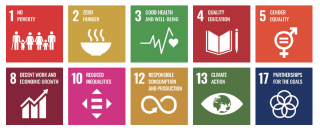
Mary’s Meals’ school feeding program contributes directly to SDG 2 (Zero Hunger), SDG 3 (Good Health and Wellbeing), SDG4 (Quality Education), and SDG 5 (Gender Equality). By addressing children’s hunger through the provision of daily school meals (SDG 2), we help to break down barriers to accessing education as well as improve attendance, participation, and learning outcomes (SDG 4). Our meals help to boost children’s health and happiness (SDG 3) and encourage girls to engage in education (SDG 5).
Mary’s Meals also contributes indirectly to SDG 1 (No Poverty), SDG 8 (Decent Work and Economic Growth), and SDG 10 (Reduced Inequalities). Research shows that our daily meals can reduce financial pressure on families by enabling households to redirect resources, which can potentially ease the effects of poverty (SDG 1). Our school feeding program creates jobs and invests in local economies (SDG 8), while helping to reduce inequalities by reaching the most vulnerable children (SDG 10). How we do this work is also important. Our unique approach is powered by strong collaboration with governments, partners, and the communities we serve – partnerships that make our work possible and reflect our commitment to SDG 17 (Partnerships for the Goals). Through our collaborative model, we support the positive development of local food systems, advancing SDG 12 (Responsible Consumption and Production) and SDG 13 (Climate Action).
KEY THEMES
The power of school meals
Our school feeding programs do more than simply provide food. Locally procured school meals delivered at scale provide an integrated approach to improving outcomes for children, their families, and communities. School meal programs are recognised as one of the most cost-effective interventions available, addressing immediate hunger while strengthening educational outcomes, improving health, and contributing to broader social equity and long-term economic development through strong partnerships.
At a global level, our work seeks to contribute to more than half of the UN’s Sustainable Development Goals. Every school day, beyond the mugs and bowls that we fill, by reliably serving a daily meal in a place of education, our programmes directly benefit children’s education and wellbeing; provide a social safety net for families and households; and support community social cohesion and system strengthening.

EDUCATION
We improve children’s access to quality education and learning by reducing hunger‑related barriers to participation and supporting attendance, concentration, and learning outcomes.

SOCIAL COHESION
We strengthen social cohesion by fostering trust, collaboration, and shared responsibility within schools and communities engaged in delivering the program.

SOCIAL SAFETY NET
We provide a vital social safety net, protecting vulnerable children and families from food insecurity and economic shocks through the stability offered by a daily school meal.

SYSTEM STRENGTHENING
We contribute to system strengthening by building sustainable, multi‑sectoral capacity across education, agriculture, health, and social protection systems to facilitate long-term development.

HEALTH & WELLBEING
We enhance children’s health and wellbeing by ensuring reliable access to nutritious food that supports growth, energy, and overall development.
EDUCATION
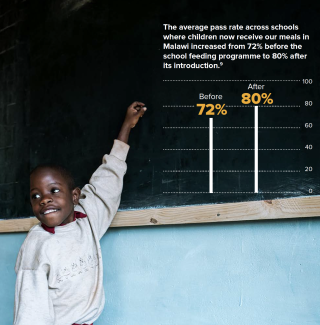
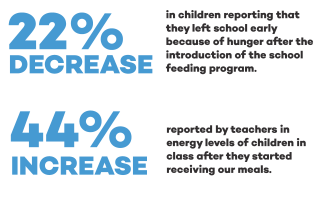
From our 2025 research, we strengthened our evidence that school meals improve children’s educational outcomes by increasing readiness to learn through reducing worry about hunger and lowering hunger levels in the classroom. Our meals support daily attendance and reduce early departures caused by hunger, while improving energy, concentration, and engagement.
We also found that school meals contribute to improved academic achievement by supporting higher pass rates, decreasing dropouts, and improving progression to higher educational levels.
In South Sudan, teachers shared that students stay longer, participate more, and concentrate better after receiving meals, with teachers noting improvements in engagement and attendance: “the meals help learners stay longer in class and participate very well.”
SOCIAL SAFETY NET
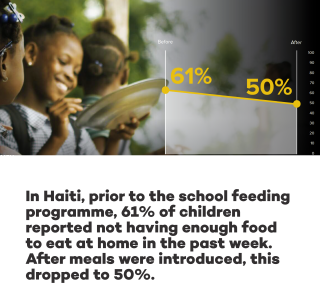
During our 2025 studies in Ethiopia, Haiti, Malawi, Zambia, Liberia, Yemen, and Zimbabwe, parents consistently reported that children return home less hungry, lowering food consumption and easing household expenditure. Although savings remain modest, especially during inflation, parents shared that the school meals program acts as a buffer from economic instability, climate shocks, and temporary periods of food insecurity.
HEALTH & WELLBEING
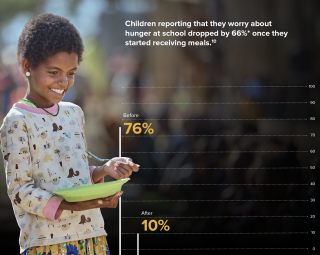
Consistent school meals significantly improve children’s health by reducing hunger, boosting energy, and reducing illness. Children across our programs report increased happiness and better ability to learn and play. Parents and teachers observe children being healthier, more energetic, and less likely to miss school because of sickness. In turn, household stress is reduced, as parents worry less about hunger, malnutrition, and fluctuating food availability, leading to greater wellbeing and some relief from financial and emotional pressure.
REDUCED ILLNESS
In Zambia, parents reported a reduction in children having common illnesses like colds and coughs during the school year.
BETTER HEALTH
In Ethiopia, parents shared that the school feeding program improved health and wellbeing by ensuring children receive nutritious meals, reducing stress and intra-household conflict.
IMPROVED HAPPINESS
92% of children reported being happy, with the school meal and the opportunity to learn identified as the main contributors to their happiness.
SOCIAL COHESION
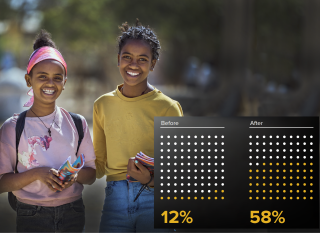
Our research across Ethiopia, Liberia, Malawi, Yemen, and Zambia in 2025 expanded our understanding that our school feeding program strengthens social cohesion at community level by creating opportunities for parents and teachers to work together and collaborate on decision‑making. Parents also reported stronger peer connections brought about by teamwork and shared responsibility, enhancing social cohesion through joint activities and encouraging collective support for education.
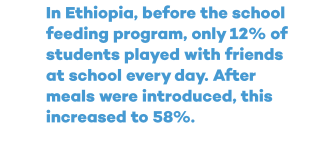
At school level, meals bring children together regardless of background, ethnicity, religion, or socio‑economic status. By eating the same meal together, social barriers are reduced and children feel an increased sense of belonging.
SYSTEM STRENGTHENING
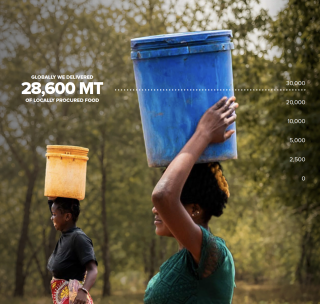
In 2025, as part of our commitment to strengthening local food systems, we delivered over 28,600 metric tonnes of locally procured food for our school meals globally.
One example of work to strengthen local food systems is our commitment to supporting smallholder farmers in Zambia through our partnership with COMACO. Mary’s Meals Zambia (MMZ) has a long-standing partnership with COMACO, a supplier that supports conservation and works with cooperatives made up of smallholder farmers in Zambia.
By sourcing maize and soya beans for our school meals from cooperatives practising conservation farming, our Zambia program boosts local production capacity, farmer incomes, and gender-inclusive leadership. COMACO’s traceability systems and continuous farmer training further enhance supply chain reliability and sustainable agriculture in Zambia. Together, this reinforces Mary’s Meals' contribution to sustainable, multisectoral development across agriculture and education, enhancing livelihoods and community resilience.
The ingredients used for the meal served in Mary’s Meals’ Zambia program were supplied by over 22,000 smallholder farmers, and more than half of them were women. These smallholder farmers belonged to 16 cooperatives, nine of which were headed by females.
As part of the partnership, all the smallholder farmers that contributed to our school meals received training in conservation farming, including soil fertility improvement, land preparation and post-harvest handling, as well as cooperative governance and leadership development training.
It costs just $31.70 to feed a child in a place of education for a whole school year.
Please give what you can today.


Fundraise
