
School feeding unlocks children’s academic potential
Mary’s Meals helps to improve children’s access to education, giving them the energy to participate and concentrate in the classroom.
Recent research by Mary’s Meals has shown that daily school meals improve a child’s education and academic achievement by lowering their level of hunger, while increasing their overall energy, engagement, and aspiration to learn. We also found that daily school meals help the children we serve get better grades and improve their chances of going on to higher education.
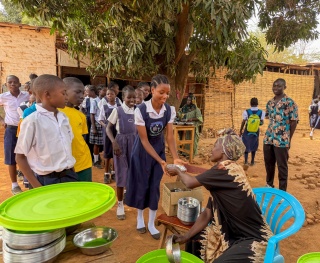
“Before meals were introduced across our programs in Ethiopia, Haiti, Malawi, South Sudan, Zambia, and Zimbabwe, 27% of children left school early because of hunger,” explains Erin Pratley, our Chief Programs Officer. “This dropped to 5% once the school feeding program had begun. Across five of our programs, teachers also reported a 44% increase in energy levels in class after the children started receiving our meals.”
In Malawi, the average pass rate across schools where children now receive our meals increased from 72% before the program to 80% after its introduction. And children in Madagascar are more than twice as likely to drop out of school when they don’t receive our meals (2% vs. 5% drop-out rate in schools with and without our school feeding program).
“I come to school every day now because I know I will have something to eat”

Before the introduction of daily meals at her school in Zimbabwe, hunger frequently kept 10-year-old Gugulethu at home. Each missed lesson caused Gugulethu to fall behind in her learning and her performance at school declined. “I didn’t come to school every day because we didn’t have food in the morning,” she says. “I would only go to school three days a week.”
Access to a daily school meal provided by Mary’s Meals is now helping to change Gugulethu’s story. The meal not only provides essential calories but also academic stability – improving her attentiveness, participation, and knowledge retention. “I come to school every day now because I know I will have something to eat,” she explains. “I can listen to my teacher and concentrate because my tummy isn’t rumbling.”
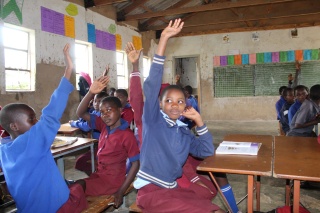
The impact on Gugulethu’s academic performance has been significant: “When I used to miss school, I would fall behind and my grades went down,” she says. “That doesn’t happen anymore. I want to become a teacher, and going to school will help me achieve that dream.”
“When I eat, it gives me interest in learning”
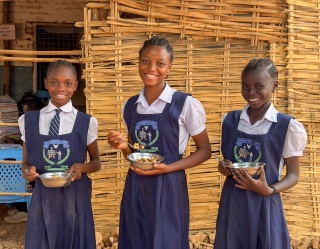
16-year-old Aishia from South Sudan used to miss school regularly because hunger disrupted her focus and motivation. “When a person does not eat, they have no energy,” she says. “Some days we will not come to school because of hunger.”
Following the introduction of Mary’s Meals at her school, Aishia’s education has been transformed by the improved nutrition that daily school meals bring. She feels energized and engaged. “When the meals were brought to the school, all of us became very active and had much more interest in learning,” she says.
“The meals have improved [her] learning because they give her energy to study and help her concentrate better,” says Aishia’s teacher.
"An educated child is more likely to escape poverty and improve her life. When the child's life improves, the family will also benefit, and the entire community can move towards greater development and stability.”
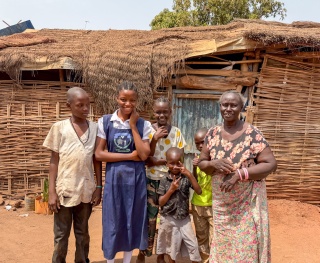
Education represents hope for Aishia and her family: “I would like to become a doctor [or] a lawyer,” she says. “I want to use my education to help my family and my community.”
Building stronger foundations for the future
In families struggling to overcome uncertainty and poverty, daily meals not only serve to alleviate hunger – they are helping children like Gugulethu and Aishia to unlock their academic potential and build stronger foundations for the future.
It costs just $31.70 to feed a child in their place of education for an entire school year.