
School feeding reinforces social and community cohesion
Mary’s Meals fosters trust, collaboration, and shared responsibility for parents, teachers, and the wider community engaged in delivering daily meals.
Our recent research has helped us further understand that providing daily school meals strengthens social and community cohesion by creating opportunities for parents and teachers to work together on their children’s education.
Parents of children that receive our meals in Ethiopia, Liberia, Malawi, Yemen, and Zambia tell us that activities aimed at creating shared responsibility for their children’s education are helping them build stronger connections with other parents within the school and the wider community.
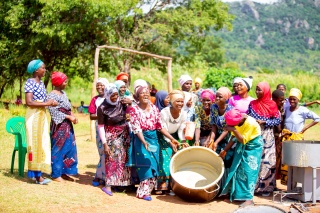
“Getting involved in preparing the meals has helped parents in Malawi build stronger relationships with other parents, while those in Zambia say that they get involved in school affairs more often because of their involvement in the school feeding program,” explains Erin Pratley, our Chief Programmes Officer. “Similarly, parents and caregivers in Liberia have told us that the community is more involved in the children’s education because members spend more time at school preparing and serving the meals.”
The children themselves say that they feel a sense of belonging when they eat the same meal, coming together regardless of their background, ethnicity, religion, or socio-economic status. For example, only 12% of students in Ethiopia played with their friends at school every day before the school feeding program. After meals were introduced, this increased to an incredible 58%.
“The meal fuels their play and builds their friendships”
Mr Yasser works as a supervisor at a school in Yemen that serves children from families living in poverty, including those internally displaced by conflict. He has seen how hunger can prevent children from building friendships and creating social bonds.
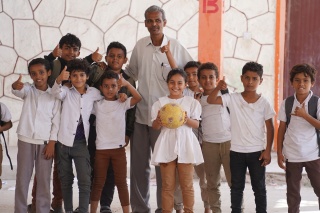
“Before the meals [were introduced], the children simply did not have the energy to play,” he says. “They would sit exhausted and the schoolyard was often a very quiet place. When they did interact, the frustration of hunger often led to arguments. There was very little teamwork or laughter because they were simply trying to survive the day.”
After eating the meal provided by Mary’s Meals, the children play and interact with a renewed sense of motivation and energy. “Once their hunger is satisfied, their energy returns. They rush to the yard to play sport,” says Mr Yasser. “The meal fuels their play and play builds their friendships. They learn to collaborate and trust each other, and they aren’t burdened by hunger or divided by who has food and who doesn’t. They are free to laugh, play, and make friends. It allows them to just be children."
“School feeding brings us together for a shared purpose”
At Mpalapata Primary School in Malawi, climate shocks and poor harvests have intensified hunger and food insecurity. Prior to Mary’s Meals, many children attended school hungry, and community engagement around education was extremely limited. “Because children did not attend school consistently, parents were also not very invested in their children’s education,” says Tiyese Tepeta, head teacher at the school.
The introduction of daily school meals galvanized the entire community and created a shared sense of purpose among teachers, parents, and learners that ensures every child receives a daily meal at school. Teachers coordinate the program and monitor progress, while parents and volunteers help cook the meal.
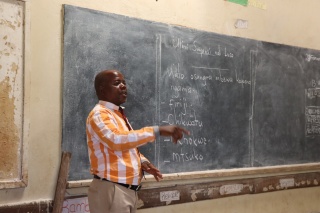
“School feeding brings us together for a shared purpose of improving education,” Tiyese says. “This shared responsibility makes children feel valued and cared for, which also motivates them to come to school more and to work hard.”
This collective involvement has strengthened social bonds within the community. Parents are now more confident sending their children to school knowing they will be fed, which has improved attendance and participation. Furthermore, spending less time cooking at home and knowing their children are more likely to stay in school all day is encouraging families to participate in community finance groups.
Daily school meals strengthen social and community cohesion
In communities shaped by hardship, the provision of daily school meals can reinforce social cohesion and build community collaboration – something that Mr Tepeta and Mr Yasser believe is essential for children to develop socially and enjoy a normal childhood.
It costs just $31.70 to feed a child in their place of education for an entire school year.