
School feeding is a gamechanger for children’s health and wellbeing
Mary’s Meals ensures children experiencing vulnerability receive reliable access to nutritious food that supports their health, growth, and development.
Diet has a profound impact on children’s health and wellbeing, and school meals have an important role to play in children's development. Beyond addressing immediate hunger, regular access to reliable school meals helps to boost a child’s nutrition and can reduce anxiety as well as improve physical health.
“Parents and teachers across our school feeding programs tell us that children who receive Mary’s Meals at school are healthier, more energetic, and much less likely to miss school because of sickness,” explains Erin Pratley, our Chief Programs Officer. “For example, parents in Zambia say that their children suffer fewer common illnesses such as coughs and colds, while in Ethiopia, they say that daily school meals help to reduce stress, leading to fewer family disputes and disagreements.”

The children we serve also report being happier, less stressed, and having more energy to learn and play. In Ethiopia, Haiti, Madagascar, Malawi, South Sudan, Zambia, and Zimbabwe, the number of children who worry about hunger at school dropped from 76% to 10% once they started receiving meals. And in Liberia, Malawi, and Zambia, 92% of children say the school meal and the opportunity to learn are the main reasons for their happiness.
Parents tell us that school meals mean that they worry less about hunger, malnutrition, and the availability of food for their children, which improves their own wellbeing and provides some relief from financial and emotional stress.
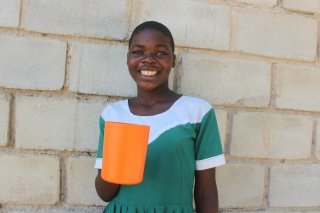
In Malawi, 13-year-old Tawina’s health was fragile before the introduction of daily school meals. Her diet lacked essential nutrients, and persistent hunger often left her weak and disengaged. “I used to feel very hungry in class and I could not listen properly to the teacher,” she says. “I felt sick all the time.”

Mary’s Meals has improved Tawina’s physical health and wellbeing. Access to consistent nutrition has improved her energy levels and helped her put on weight. “When I eat at school, I have strength and energy that allows me to play with my sibling, and I can learn better,” she says. “I don’t feel weak or complain of stomach pains anymore.”
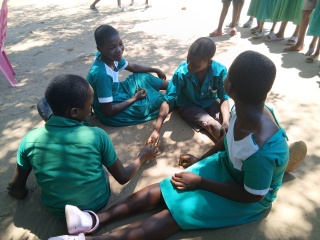
The benefits of school feeding also extend to Tawina’s mental and emotional health. She reports increased happiness, confidence, and motivation. Her concentration and academic performance have also improved, and she interacts more positively with her classmates. “I am happy to go to school now because I know the cup of porridge will give me enough strength to get through the day,” she explains.
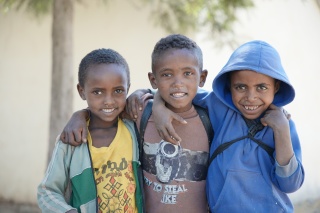
Seven-year-old Meareg’s health and wellbeing were in decline before school feeding started at his school in Ethiopia. He suffered from a chronic lack of appetite and severe weight loss due to the family’s inability to afford food. Doctors said that his health wasn’t improving because the underlying cause – hunger – remained unaddressed.
“He was frequently ill,” remembers the Deputy Principal at Meareg’s school. “On two separate occasions, his class teachers and I had to physically carry him back to his home because he was too unwell to remain in class.”
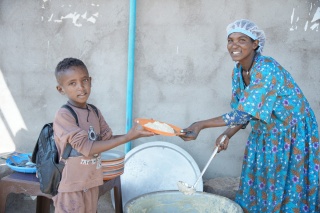
The day Meareg started receiving daily school meals marked a dramatic turning point in his health. The daily bowl of porridge has acted as a physical lifeline, leading to a step-by-step improvement in his overall health. Today, Meareg is a different child. He wakes up every morning with a sense of excitement and an eagerness to attend school, motivated by the meals he receives.
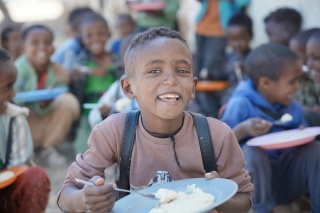
“His health has improved substantially,” says the Deputy Principal. “I can say with absolute certainty that the school feeding program has been crucial for this change, not just for Meareg, but for many children in our school.”
Daily school meals enhance children’s health and wellbeing
The impact of school feeding on Tawina and Meareg’s health and wellbeing is profound. Reliable access to nutritious food enhances their growth, energy, and overall development – and it extends far beyond their own personal circumstances to have a deep and positive knock-on effect on the lives of their families and communities.
It costs just $31.70 to feed a child in their place of education for an entire school year.