
International School Meals Day - how 16 cents can help change a life and a whole community
Today (Thursday, March 12, 2026), Mary’s Meals will serve more than 3 million school meals to children living in 16 of the world’s poorest countries. And tomorrow, again, more than 3 million children will receive a nutritious meal in their place of educat
It costs just 16 cents to feed one child for one day, but we know the value of that meal is so much more. For children receiving school meals, research consistently shows improved attendance, concentration, and an increased chance of progressing in education. The benefits also stretch beyond schools to families and the wider society.
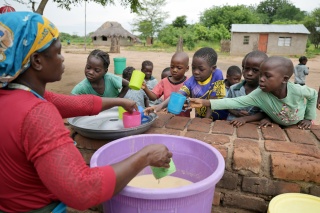
One example of the far-reaching benefits of Mary’s Meals’ school feeding program is the support for farmers in Zambia through long-standing partnerships with local suppliers that promote conservation and work with cooperatives made up of smallholder farmers.
Erin Pratley, Chief Programs Officer at Mary’s Meals International, says: “We source maize and soya beans for our school meals in Zambia from cooperatives practising conservation farming. This means our Zambia school feeding program boosts local production capacity, farmer incomes, and gender inclusive leadership. You can’t even imagine how far 16 cents (the worldwide cost per meal) goes.”
Our suppliers’ traceability systems which track from source to delivery and continuous training of farmers further enhance supply‑chain reliability and sustainable agriculture in Zambia. Together, this reinforces Mary’s Meals’ contribution to sustainable, multi‑sectoral development across agriculture and education, enhancing livelihoods and community resilience.
School meals = Gender inclusivity
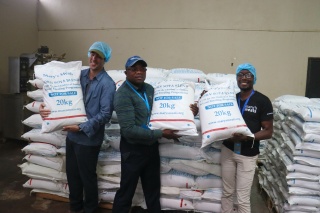
The ingredients for meals served in Mary’s Meals’ Zambia school feeding program were supplied by over 22,000 smallholder farmers – more than half of whom were women. These smallholder farmers belonged to 16 cooperatives, nine of which were headed by females.
School meals = Building local capacity
As part of Mary’s Meals’ supplier partnership with COMACO in Zambia, all smallholder farmers who contribute to the school feeding program received training in conservation farming, including soil fertility improvement, land preparation and post-harvest handling, as well as cooperative governance and leadership development training.
School meals = Investing in the local economy
These partnerships enable Mary’s Meals to procure high-quality maize and soya beans in large enough quantities to serve meals to more than 605,000 children every school day while helping to generate income for local smallholder farmers.
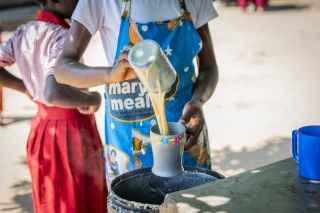
In 2025, Mary’s Meals delivered over 28,600 metric tons of locally procured food for our school meals globally as part of its commitment to strengthening local food systems.